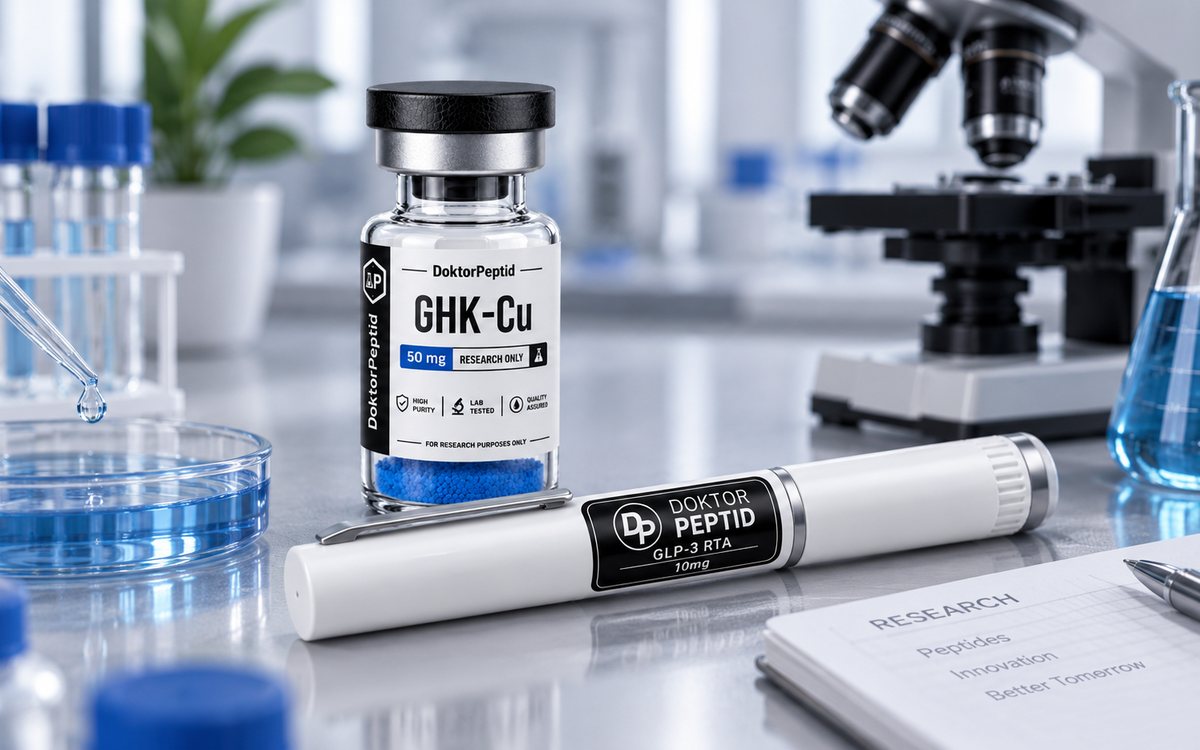
Criteria for selecting peptide suppliers for research

For a peptide to enter an experiment, the name on the label or the declared concentration in the catalog is not enough. Peptide supplier selection criteria determine whether the results will be interpretable, repeatable, and defensible. Unverified compound identity, unclear purity, or improper storage may affect the observed effect more than the experimental design itself.
Peptides are sensitive molecules. Degradation, oxidation, hydrolysis or aggregation can occur during handling, transport and prolonged storage. A reputable supplier therefore does not just sell a labeled vial, but provides measurable quality parameters, batch-specific documentation and a clear framework for use exclusively for scientific purposes.
Peptide supplier selection criteria that carry weight
Purity must be supported by analysis
Declared purity ≥99 % is a relevant starting point, but not a stand-alone proof of quality. When choosing a supplier, ask what method was used to determine the purity and whether the result is available for a specific batch. For peptides, the common standard is HPLC analysis, most often reversed-phase HPLC, which helps separate the target peptide from synthesis by-products and other impurities.
The percentage on the product page alone does not tell you what impurities are in the sample or what their profile is. An HPLC chromatogram may show a dominant peak for the target compound, but reading it correctly requires context: the method used, the detection wavelength, the retention time, and the lot number being analyzed. For routine research procurement, it is essential that the supplier can provide this information in a clear and non-evasive manner.
For more demanding projects, confirmation of molecular weight is also important. Mass spectrometry helps to verify that the analyzed compound corresponds to the expected molecular weight of the peptide. HPLC primarily answers the question of purity, mass spectrometry supports identification. These methods are not substitutes, but complement each other.
The COA should belong to a specific batch
Certificate of Analysis, often referred to as a COA, is a practical document for laboratory records. It should be linked to the batch number listed on the packaging, include the product name, purity result, analytical method used, and date or identification of the analysis. If the COA is a generic document without a link to the batch, its evidentiary value is limited.
It is important to distinguish between a marketing claim and a documentable statement. The phrase „lab-tested“ without further details does not have the same informative value as a protocol that can be attached to a vial in your lab inventory. The supplier should be transparent about whether a COA is available with the product or upon request.
For products intended for comparative experiments, it is worth keeping documentation, along with an internal record of the date of receipt, storage, and use. This will make it easier to track down possible differences between batches later. This is not unnecessary administration – it is part of the control of experimental variables.
Identity, form and quantity must be unambiguous
A quality supplier will provide the exact name of the substance, the declared quantity in the vial, the form of the product and, if applicable, information about the salt or modification. For peptides with similar names, different fragments, or acetylated or amidated variants, even a small difference in labeling may indicate a different molecule under investigation.
Also, check whether the weight on the label means the net weight of the peptide or the total weight of the material including counterions and residual moisture. This detail may not always be crucial in a typical catalog purchase. However, it can be important for precise concentration planning, comparisons between suppliers, or sensitive cell models.
Lyophilized peptide is a practical form for transport and storage, but after reconstitution, the purity of the solvent used, aseptic handling, and solution stability become increasingly important. The supplier is not intended to replace laboratory procedures, but should provide adequate information on the storage conditions of the supplied material.
Warehousing and logistics are not secondary details
Even an analytical grade peptide can lose its properties if handled incorrectly. Assess whether the supplier clearly communicates recommended storage conditions before and after reconstitution, packaging type, and delivery procedure. For sensitive research compounds, light-tight packaging, securely closed vials, and minimizing unnecessary time in transit are relevant.
Fast shipping has a laboratory dimension, not just a convenient one. If a workplace needs material for a planned experiment, an unclear shipping date complicates the planning of cells, reagents, and instrument capacities. A supplier that ships orders within 24 hours, clearly states the availability status, and transparently communicates delivery conditions to Slovakia, the Czech Republic, and within the EU, reduces operational uncertainty.
However, a distinction must be made between fast delivery and maintaining appropriate conditions. The optimal solution depends on the stability of the particular peptide, the season, the distance and the form of the product. For questions that are not answered in the documentation, expert customer support should be available to provide a substantive answer.
Compare price with level of evidence
The lowest price per milligram does not necessarily mean the lowest cost of the experiment. If the cheaper material does not have a batch COA, does not list the analytical method, or comes from an unclear origin, the risk of retesting may outweigh the initial savings. In research, price is relevant, but it must be considered along with purity, identity, documentation, and availability.
On the other hand, a high price does not automatically confirm quality. Exaggerated marketing claims, supposedly exclusive formulations without analytical data, or vague labels such as "pharmaceutical quality" are grounds for additional questions. The research supplier should communicate specific parameters, not replace data with impression.
With regular sampling, it also helps to evaluate batch-to-batch consistency, not just one successful order. If a laboratory uses the same peptide over a long period of time, a stable level of quality control, batch traceability, and predictable supply are of high practical value.
The legal framework and purpose of use must be clear
Peptides sold as research chemicals are not medicines or dietary supplements. They are not intended for the diagnosis, treatment, prevention of disease or for human or animal consumption. A reputable supplier does not blur this line and does not use medical promises to promote sales.
A clear „For Scientific Purposes Only“ label protects the proper use of products and the credibility of the research community. Technical descriptions can explain the mechanisms or areas in which the compound is being studied—for example, cell signaling, neurobiology, metabolism, or skin research. However, they are not intended to create the impression of an approved therapeutic use.
Verify that terms and conditions, product information, and customer communications respect this framework. If a supplier promises specific health outcomes or provides dosing instructions for an investigational compound, this is a serious signal that their approach to quality and regulation may not be reliable.
Practical procedure before the first order
Before including a new supplier in your procurement, prepare a short qualification process. Check the product specification, declared purity, availability of HPLC analysis and batch-specific COA. Then, verify product identity, storage instructions, inventory status and shipping conditions.
When ordering for the first time, it is wise to start with material intended for a validation experiment and record the batch number. Do not judge results in isolation. Consider your cell model, protocol used, solvent, storage conditions, and time since reconstitution. Quality material supports sound research, but is not a substitute for good experimental design.
DoktorPeptid bases the selection of research peptides on declared purity ≥99 %, HPLC analyses, batch quality control, and the ability to request an analysis protocol. Such parameters allow the laboratory to make decisions based on data, not just trust in the product name.
A good supplier will not only provide you with a product, but also with the assurance that you know what material you are working with. Therefore, before every new purchase, prioritize traceability and analytical evidence over vague promises - these are the ones that give your results a more solid foundation.
Related products
Produkty, ktorých sa táto téma týka: Baktériostatická voda – skladom na Slovensku. Ceny a dostupnosť nájdete v sekcii všetky produkty, doplnky ako dávkovacie perá a zvýhodnené balíčky sú v samostatných kategóriách.
Všetky produkty sú určené výhradne na laboratórny výskum.