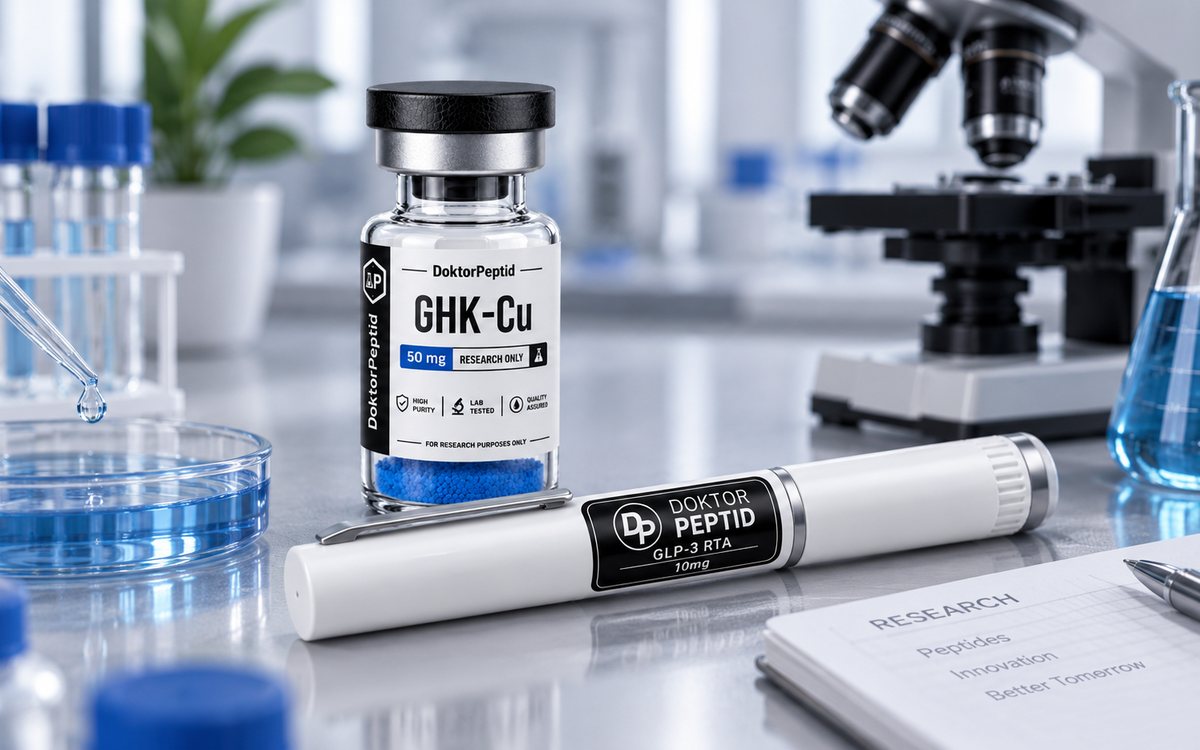
Retatrutide in cell metabolism research

Metabolic research often fails not because of a lack of data, but because of overly simplistic explanations. Retatrutide is attracting attention in metabolic research precisely because it does not activate just one signaling pathway. It is a peptide investigated as a triple agonist of the GLP-1, GIP, and glucagon receptors, i.e. receptors with different, and sometimes complementary, effects on cellular metabolic signaling.
For laboratories, this combination is particularly valuable as a tool for studying the interplay between energy expenditure, nutrient processing, cAMP signaling, and cell type responses. However, it requires careful interpretation. Results from one cell line cannot be automatically extrapolated to a tissue, organism, or clinical context.
Why retatrutide is changing questions in metabolism research
GLP-1, GIP and glucagon receptors are G protein-coupled receptors. Upon activation, they can influence cyclic adenosine monophosphate concentration, protein kinase A activity, secretion, gene expression and regulation of energy substrates. However, each of the receptors acts in a different biological environment and its significance varies depending on the cell type, model type and experimental conditions.
GLP-1 signaling is often studied in relation to pancreatic islets, beta cell secretory activity, and regulation of glucose response. The GIP receptor is of interest for research into incretin signaling, adipocytes, and lipid metabolism. The glucagon receptor is primarily associated with hepatic processes, mobilization of energy stores, and regulation of glucose metabolism.
Retatrutide, as a molecule with activity against all three targets, allows us to investigate what happens when these axes are not evaluated in isolation. This does not mean that their effects simply add up. In a particular model, one receptor may dominate, another may be expressed only weakly, and yet another may be functionally silenced by culture conditions. This is why verifying receptor expression before a pivotal experiment is more than a formal step.
Retatrutide metabolism research: what can be observed in vitro
In vitro, it makes sense to start with a question, not a molecule. If the goal is to understand receptor activation, reporter systems or cell lines with defined receptor expression may be appropriate. If the laboratory is investigating metabolic response, primary hepatocytes, adipocytes, pancreatic cell models, or more complex co-cultures may be more beneficial.
In receptor pharmacology, cAMP generation, beta-arrestin recruitment, intracellular receptor internalization, and signal time course are commonly assessed. These parameters help to distinguish whether a molecule elicits a short, intense response, a longer-lasting activation, or differential signaling between individual receptors. The so-called signaling preference may be relevant, but its interpretation depends on the assay and reference agonist used.
In hepatic models, researchers can monitor changes in the expression of genes associated with glucose metabolism, levels of secondary messengers, or markers of energy substrate utilization. In adipocyte models, attention can focus on lipolytic markers, lipid accumulation, mitochondrial parameters, or inflammatory signaling. In islet and beta-cell models, secretory responses and cell viability in a well-defined experimental environment are relevant.
However, the choice of model itself determines the limits of the result. Immortalized cell lines provide good reproducibility, but their receptor profile may not match the primary tissue. Primary cells may be biologically closer to the physiological state, but they introduce higher variability between donors and limited culture life. Organoids and multicellular systems can provide a broader context, but at the cost of more demanding analytics.
Kinetics are important, not just the endpoint
For peptides with multi-receptor activity, it is not sufficient to compare a single endpoint at a single time point. Short-term signaling may look different than the response after longer incubation, as receptor desensitization, internalization, or adaptation of the cell to the altered signal takes place.
Practical experimental designs therefore often include multiple time points, a suitable reference substance, and controls without the test compound. If multiple receptors are being studied, it is wise to include selective pharmacological controls or models with altered receptor expression. Without these, it can be difficult to determine what portion of the observed effect is related to a particular pathway.
From concentration to data interpretation
The concentration response in a cell assay is not a guide to application outside the laboratory. It is a tool to determine the relationship between exposure and the measured parameter in a well-defined system. With retatrutide, it should be noted that apparent efficacy may vary depending on receptor density, medium composition, serum proteins, cell condition, and sensitivity of the analytical method.
It is relevant to distinguish between affinity, potency and biological effect. A molecule may exhibit measurable receptor activity, but its resulting impact on a metabolic marker varies in different cells. Similarly, a change in gene expression does not necessarily mean a change in metabolite flux or a functional shift in the cell. Therefore, a combination of functional assays, protein analysis and transcriptomic or metabolomic data provides a more convincing picture than an isolated result.
Special attention should be paid to monitoring cytotoxicity and overall culture status. A decrease in metabolic signal may at first glance appear to be a specific modulation of a pathway, but may in fact be a consequence of cell stress, inappropriate solvent, or technical variability. Parallel viability measurements and matrix control of the assay are essential for interpretation.
The quality of the research compound is part of the experiment
In peptide research, purity is not just a catalog number. Impurities, degradation, or batch-to-batch differences can affect the reproducibility of receptor and cellular assays. This is especially true in experiments where subtle differences in signaling or gene expression are being assessed.
Before including a compound in a study, it is advisable to check the material identity, declared purity, batch number, and available analytical documentation. HPLC analysis helps to assess the purity profile, while mass spectrometry supports verification of molecular weight and identity. When working with comparative series, it is important to archive documentation for each batch used directly in the laboratory records.
It is also important to store according to the manufacturer's technical documentation and minimize unnecessary sample handling cycles. Peptide stability can depend on humidity, temperature, light, and time after preparation of the working material. A consistent sample preparation procedure and a clearly recorded handling history reduce the risk of a technical problem being mistaken for a biological discovery.
DoktorPeptid states a declared purity of at least 99% for research products and allows you to request available batches. analysis protocol. For a laboratory, such transparency is particularly practical when it needs to defend the origin of the material, the traceability of batches, and the quality of the inputs to the experiment.
Boundaries that must be maintained
Retatrutide is an investigational compound and results obtained in cell models should remain within the scope of the model. Products intended for scientific purposes only are not drugs, dietary supplements, or materials for human or animal consumption. Responsible research therefore separates mechanistic hypothesis from therapeutic claims.
This does not diminish the value of the topic. On the contrary, a well-designed in vitro experiment can show whether it makes sense to continue into more complex models, which receptors are key to the observed phenomenon, and what analytical methods will be needed next. With retatrutide, the most interesting answers are often not found in a single number, but in how receptor activity, cell type, time, and the quality of the material used overlap.
For an experiment to be informative, start with a defined hypothesis, validate the receptor context of the model, and document each batch as rigorously as the data itself. This creates research that can be revisited, repeated, and intelligently built upon.
Related products
Produkty, ktorých sa táto téma týka: Nad+ – skladom na Slovensku, GLP-3 RTA – skladom na Slovensku, Baktériostatická voda – skladom na Slovensku. Ceny a dostupnosť nájdete v sekcii všetky produkty, doplnky ako dávkovacie perá a zvýhodnené balíčky sú v samostatných kategóriách.
Všetky produkty sú určené výhradne na laboratórny výskum.