Regenerative peptides: what the research shows

Regenerative peptides research does not base on a single answer, but on a series of precisely controlled questions. How does a given sequence affect cell migration? Does it alter signaling related to the extracellular matrix? Is the observed effect reproducible across batches, cell lines, and experimental conditions? It is the difference between an interesting signal in a culture dish and a reliable scientific finding that determines the value of the data obtained.
Regeneration is a broad biological concept. It includes cell communication, inflammatory pathways, proliferation, differentiation, angiogenesis, and the organization of collagen and other matrix structures. Therefore, peptides studied in this area are not a universal category with a single mechanism. Each molecule, model, and monitored parameter requires its own experimental justification.
What is regenerative peptide research investigating?
In the laboratory context, regenerative peptides are most often evaluated as modulators of cell signaling. Researchers are interested in whether the compound alters gene expression, signaling pathway activity, cell movement, or the production of selected proteins. Possible interactions with oxidative stress, the cytokine environment, or tissue matrix repair processes are also relevant.
The basis is usually in vitro models with a defined cell type. Fibroblasts can provide information on marker changes related to matrix and skin biology. Endothelial cells are useful for questions related to cell migration and vascular signaling. Neurobiological hypotheses work with relevant neural cell models. However, the result obtained on one line cannot be automatically transferred to another line or to a complex organism.
It is important to distinguish a mechanistic signal from an interpretation that would go beyond the available data. A change in a fluorescent marker, protein expression, or cell morphology is a measurable observation. However, it does not in itself demonstrate therapeutic effect, clinical relevance, or safety for use in the body. Investigational compounds are intended for scientific purposes only and are not drugs, dietary supplements, or materials for human or animal consumption.
BPC-157, TB-500 and GHK-Cu in laboratory hypotheses
Frequently searched molecules include BPC-157, whose research hypotheses mainly concern signaling processes associated with tissue response and cellular adaptation. When evaluating, it is necessary to precisely determine which endpoint is being monitored. This may include, for example, the profile of selected genes, the dynamics of cell movement, or changes in a controlled model of cell layer damage.
TB-500 is being studied in relation to thymosin beta-4 fragments and biological processes involving cytoskeletal dynamics and cell migration. Given the complexity of these processes, it makes sense to combine multiple types of measurements. A single method may capture a correlation, but alone it usually does not elucidate the mechanism.
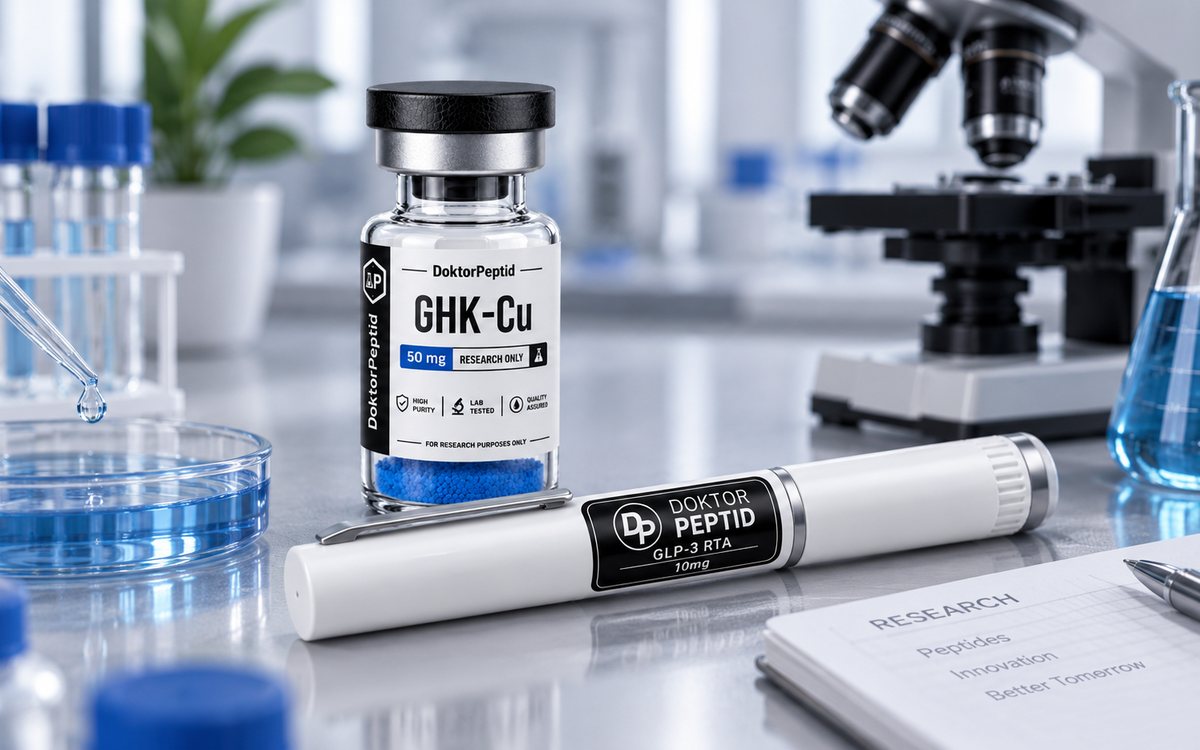
GHK-Cu represents a separate category as it is a peptide complex with copper. Research is focused on its relationship to cell communication, matrix proteins, stress response and skin models. It is particularly important to work with appropriately set controls for this compound, as the interpretation can be affected by the presence of the metal ion itself, the composition of the medium and the stability of the complex under specific conditions.
From hypothesis to data: design that stands the test of time
A quality experiment does not start with the selection of a popular molecule, but with a clear hypothesis. If the peptide is to modulate a specific signaling pathway, the primary endpoint, appropriate control, and analysis method must be defined in advance. Subsequent addition of hypotheses according to the obtained result may lead to inconclusive conclusions.
In regeneration models, it is practical to distinguish experiments focused on cell viability from experiments that assess migration, expression profiles, or secretion of markers. A higher signal in a viability assay does not necessarily mean higher proliferation. A change in a scratch model may not automatically reflect migration alone, as cell growth, culture density, and the method of image analysis can also affect the result.
A more convincing outcome is obtained when a single phenomenon is verified by multiple independent approaches. It is appropriate to add protein measurement to expression data, and a quantified functional endpoint to image analysis. Technical and biological replicates, blinded evaluation where feasible, and transparent recording of excluded data points are also necessary.
The time dimension is of fundamental importance in peptide research. A short-term response may indicate activation of a signaling pathway, while a later time point may reveal adaptation or a reversal. Conclusions should therefore not be based on a single sample. The choice of time points must be based on the biology of the model, not just on the operational simplicity of the experiment.
Why sample quality determines the result
A biological result can be sensitive to the identity, purity and integrity of the substance under investigation. With peptides, it is not just the declared name on the vial. The research laboratory needs to know what batch it is working with, what is the declared purity, what analytical methods were used and whether documentation for the given batch is available.
HPLC analysis provides important insight into chromatographic purity. Mass spectrometry complements verification of expected molecular weight and identity. No single data point should be interpreted in isolation. The combination of analytical documentation, correct labeling, batch traceability, and controlled conditions during storage and transport is relevant.
Declared purity ≥99 % is an important quality parameter, but does not eliminate the need for own methodological control. Impurities may have different nature and significance depending on the sensitivity of a particular assay. In the case of very subtle biological differences, it is reasonable to compare multiple batches, include appropriate controls and monitor whether the effect is repeated independently of the supply.
For research teams, it is a practical option to request batch analysis protocol before including the material in an important project. For products intended exclusively for scientific research, DoktorPeptid emphasizes batch quality control, HPLC analysis, and the availability of analytical documentation upon request. Such an approach does not guarantee the outcome of the experiment, but it reduces uncertainty on the input material side.
Storage is not an administrative detail
Peptides can be sensitive to temperature, humidity, light, and repeated handling. Therefore, the recommended storage conditions for the specific product must be followed from receipt of the shipment until the experiment. Neglecting this step may alter the quality of the material without it being immediately apparent.
Documentation of sample work is also important. A record of the date of receipt, batch number, storage conditions, and experimental preparation makes it easier to trace the cause of an unexpected result later. In terms of reproducibility, such discipline is often of greater value than additional explanations after the end of a series of measurements.
Limits of evidence and responsible interpretation
Regenerative research attracts attention because it deals with biologically attractive processes. However, this also increases the risk of overinterpretation. The in vitro model is a deliberately simplified system. It does not have the full tissue architecture, immune interactions, pharmacokinetics, or organismal variability.
There are significant differences between the models. Primary cells may be biologically closer to real tissue, but they introduce greater variability. Immortalized cell lines promote standardization and accessibility, but may not accurately represent the physiological state. The right choice therefore depends on the question, not on which model is generally considered better.
Responsible research also communicates negative or ambiguous results. If the effect depends on cell type, incubation time, or specific methodology, this is just as much a part of the conclusion as a positive finding. It is this kind of precision that allows other institutions to repeat, refine, or refute the experiment.
The most rewarding path with regenerative peptides is through a well-documented sample, a realistically set hypothesis, and data that can withstand repeated verification. When the quality of the material, methodology, and interpretation are under control, even a seemingly small laboratory signal can be a valuable basis for the next scientific question.
Related products
Produkty, ktorých sa táto téma týka: BPC-157 – skladom na Slovensku, TB-500 – skladom na Slovensku, GHK-Cu – skladom na Slovensku, Baktériostatická voda – skladom na Slovensku. Ceny a dostupnosť nájdete v sekcii všetky produkty, doplnky ako dávkovacie perá a zvýhodnené balíčky sú v samostatných kategóriách.
Všetky produkty sú určené výhradne na laboratórny výskum.