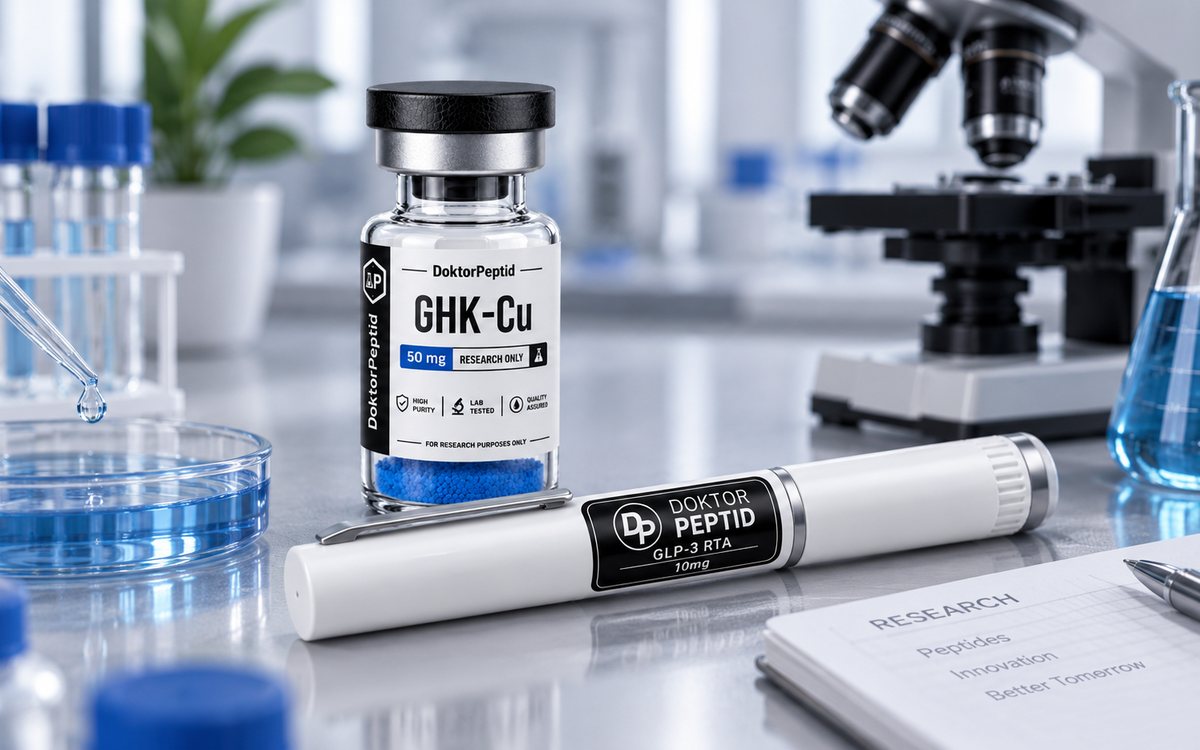
Retatrutide and metabolic research in the laboratory

Retatrutide metabolic research is attracting attention mainly because this peptide compound does not work with only one signaling pathway. In the laboratory context, it is studied as an agonist of GLP-1, GIP and glucagon receptors. It is the combination of three targets that makes retatrutide an interesting tool for studying metabolic signaling, energy balance regulation and receptor response in cellular models.
However, for the research community, it is not enough to know the popular description of the mechanism. It is important to understand which hypotheses retatrutide can help test, where the limits of interpretation of the results are, and what role analytically verified quality of the investigated substance plays. When working with peptides, even small differences in purity, degradation, or handling can significantly affect the reproducibility of the experiment.
What makes retatrutide specific for metabolic research?
GLP-1, GIP and glucagon are among the hormones with an essential role in the regulation of metabolism. Their receptors are part of the G protein-coupled receptor family and, upon activation, can influence the production of second messengers, such as cAMP, and subsequent cellular responses. Retatrutide is being investigated as a triple agonist, i.e. a molecule capable of activating all three of the above receptor systems.
This feature expands the possibilities of experimental design. The researcher does not have to follow only the isolated response of a single receptor, but can compare the relative contribution of individual pathways in the same model. Appropriately set up testing can assess receptor selectivity, concentration-dependent activity, response kinetics, or changes in the expression of downstream markers.
However, triple agonism also complicates interpretation. The resulting effect may not be a simple sum of three separate mechanisms. The type of cell line used, the density of receptors on the cell membrane, the culture condition, the composition of the medium, and the exposure time are all important. What is manifested in one transfected line may not have the same character in primary cells or in a more complex model.
Three receptor axes, three distinct questions
Activation of the GLP-1 receptor is often associated with the investigation of signaling related to glucose homeostasis and the secretory response of cells. The GIP receptor provides another level of study of incretin signaling, with its effects depending on the model and the biological question being investigated. The glucagon receptor is of particular interest in terms of energy turnover, hepatic signaling, and the relationship between catabolic and anabolic processes.
For retatrutide, it therefore makes sense to formulate a hypothesis precisely. Rather than asking in general terms whether the compound „works,“ it is more appropriate to ask how cAMP signaling changes with different receptor expression, whether different receptor internalization dynamics are observed, or how the response profile changes after blocking one of the three pathways. Such an approach generates data that can be compared and repeatedly validated.
What laboratory models have practical value?
Receptor cell assays are a fundamental tool. Cell lines with defined expression of GLP-1R, GIPR or GCGR allow to separate individual mechanisms and gain insight into activity on a specific target. Reporter assays, cAMP measurement or functional assays of signaling cascades can provide quantifiable output for comparison with reference agonists.
The next layer is models with endogenous receptor expression. Here, the biological context is closer to the natural environment, but the number of variables increases. Before starting the experiment, it is therefore advisable to verify the expression of relevant receptors and determine whether the marker of interest is indeed related to the activated pathway. Without this control, there is a risk that the result will be attributed to retatrutide, although it is explained by the variability of the model.
Competition binding experiments and analysis of signaling bias may be useful in investigating receptor preference. Two agonists may elicit a similar maximal response in a single assay but differentially activate downstream mechanisms. Retatrutide should therefore not be evaluated by a single parameter. A combination of binding, functional response, and time course will usually provide a more accurate picture.
More complex systems, such as co-cultures or organoid models, can help to study intercellular communication. Their advantage is higher biological relevance, but the disadvantage is more demanding standardization. With a limited number of samples, it may be more reasonable to start with a simple receptor assay, confirm the basic signal, and only then move on to a more complex model.
Experimental design: what to check before interpreting data
With peptide research compounds, technical discipline is part of the scientific question. The first step is to clearly define the purpose of the experiment, the primary endpoint, and an appropriate control. Negative controls, vehicle, and reference agonist are not formalities. They allow us to distinguish the true receptor response from assay background, cell variability, or the effect of the solvent itself.
Sample stability is also important. Peptides can be sensitive to improper storage conditions, repeated freeze-thaw cycles, or prolonged exposure of the prepared solution outside the recommended regime. Working aliquots, consistent date marking, and documented handling procedures reduce the risk of batch-to-batch variation before the measurement begins.
When analyzing data, it is important to distinguish between efficacy, maximal effect, and biological relevance. A shift in the concentration-response curve may indicate a difference in potency, but does not in itself explain the mechanism. If the response changes only within a narrow range of conditions, this may be a biologically interesting phenomenon, but also a technical artifact. Replications across days, cell passages, and reagent lots are therefore essential.
Material quality is not a secondary parameter
If the goal is to sensitively compare receptor responses, the investigational compound must have clearly documented parameters. A declared purity of ≥99 % is an important starting point, but a number alone without analytical context is not enough. HPLC analysis helps assess the purity profile, while mass spectrometry supports verification of the identity of the molecule.
It is of practical value for the laboratory to be able to request analysis protocol of a particular batch. It allows you to link the measured data to the material used and improves traceability when repeating the experiment. Batch quality control is especially important in longer-term projects where results are obtained gradually and multiple deliveries are used.
DoktorPeptid treats retatrutide as a research chemical intended for scientific purposes only. Transparent documentation, proper storage, and an emphasis on analytical verification are more relevant to serious metabolic research than unverified marketing claims.
The boundaries between a research signal and a medical conclusion
Retatrutide is also being studied in the clinical setting, but laboratory results cannot automatically translate into conclusions about the effect in humans. The cellular model does not capture all physiological regulation, pharmacokinetics, tissue interactions, or individual variability of the organism. Conversely, clinical findings are not a substitute for mechanistic experiments that explain why the observed effect may occur.
This limit is also essential when communicating results. Retatrutide is not a drug, food supplement or material intended for human or animal consumption. Research material should be used by qualified persons in an appropriate laboratory setting and in accordance with the relevant workplace rules.
The most valuable experiments with retatrutide do not arise from an attempt to confirm a previously expected result. They arise from a precise question, an appropriately chosen model, well-documented material, and a willingness to distinguish between an interesting signal and reliable evidence. This is how metabolic research moves from an attractive hypothesis to data that will stand up to further verification.
Related products
Produkty, ktorých sa táto téma týka: GLP-3 RTA – skladom na Slovensku, Baktériostatická voda – skladom na Slovensku. Ceny a dostupnosť nájdete v sekcii všetky produkty, doplnky ako dávkovacie perá a zvýhodnené balíčky sú v samostatných kategóriách.
Všetky produkty sú určené výhradne na laboratórny výskum.