How longevity peptides are changing cellular research

Aging is not a single biological process, but a series of changes in cell signaling, energy metabolism, proteostasis, inflammatory response, and the ability of tissues to respond to damage. This is why longevity peptides are of growing interest to laboratories seeking more precise tools to investigate these interconnected mechanisms. They are not a shortcut to a long life. They are research compounds that can help track specific signaling pathways and cellular responses in defined experimental models.
For qualified research, it is crucial to distinguish an interesting hypothesis from a reproducible result. For peptides, this means working with a clearly described model, appropriate controls, analytically validated material, and realistic interpretation of the data. A promising mechanism observed in cell culture does not automatically represent a clinical effect or confirmation of efficacy in another biological system.
What is being researched under the term longevity peptides?
The term longevity peptides does not refer to one strictly defined chemical class. In laboratory practice, it rather encompasses peptide compounds studied in relation to cell regeneration, oxidative stress, neurobiology, metabolic signaling, mitochondrial function, or skin biology. Their common denominator is not a guaranteed result, but a research question: how a particular peptide changes the behavior of a chosen model.
Some peptides are analyzed in models of tissue damage and repair, others in monitoring growth factors, cell differentiation or intercellular communication. A separate area is metabolic research, where receptors and signaling axes related to the regulation of energy balance are monitored. In the case of neuroactive peptides, the subject of interest may be the response of cells to stress stimuli, the expression of selected markers or changes in signaling.
It is important not to narrow longevity to a single biomarker. For example, a change in cell proliferation may be relevant in one model, but without additional data it says nothing about the quality of cell renewal, long-term stability, or safety profile. A quality design therefore combines multiple measurements and interprets them in the context of the system used.
Why cell signaling is more important than marketing labeling
Peptides function as specific molecular signals or modulators of biological processes. Their effect in an experiment depends on the structure of the peptide, the target receptor or interaction pathway, the cell type, the culture state, the incubation conditions, and the method of evaluation. Two experiments with the same substance name can yield different data if even part of this setup differs.
Therefore, it is more appropriate to ask what mechanism the laboratory wants to test rather than which product has the most striking name. In the field of regeneration, monitoring cell migration, extracellular matrix or markers of damage response may be relevant. In cellular energy research, attention is focused on mitochondrial activity, redox state and metabolic pathways. In skin models, collagen synthesis, fibroblast activity or response to oxidative stress may be measured.
This precision protects the project from overly broad conclusions. If a peptide affects a specific marker in a single cell line, the correct wording is that a measurable effect on that marker was observed under the given conditions. Not that the compound „slows down aging.“ Such a distinction in communication is the basis of responsible scientific content.
Research areas and relevant models
Regeneration, matrix and response to damage
This area investigates peptides of interest in models of tissue repair, cell migration, and extracellular matrix-associated signaling. BPC-157 and TB-500 are among the most frequently discussed research compounds, but the extent and quality of available evidence varies by model and endpoint. It is essential for a laboratory to accurately define whether it is testing, for example, cell viability, migration, gene expression, or another outcome measure.
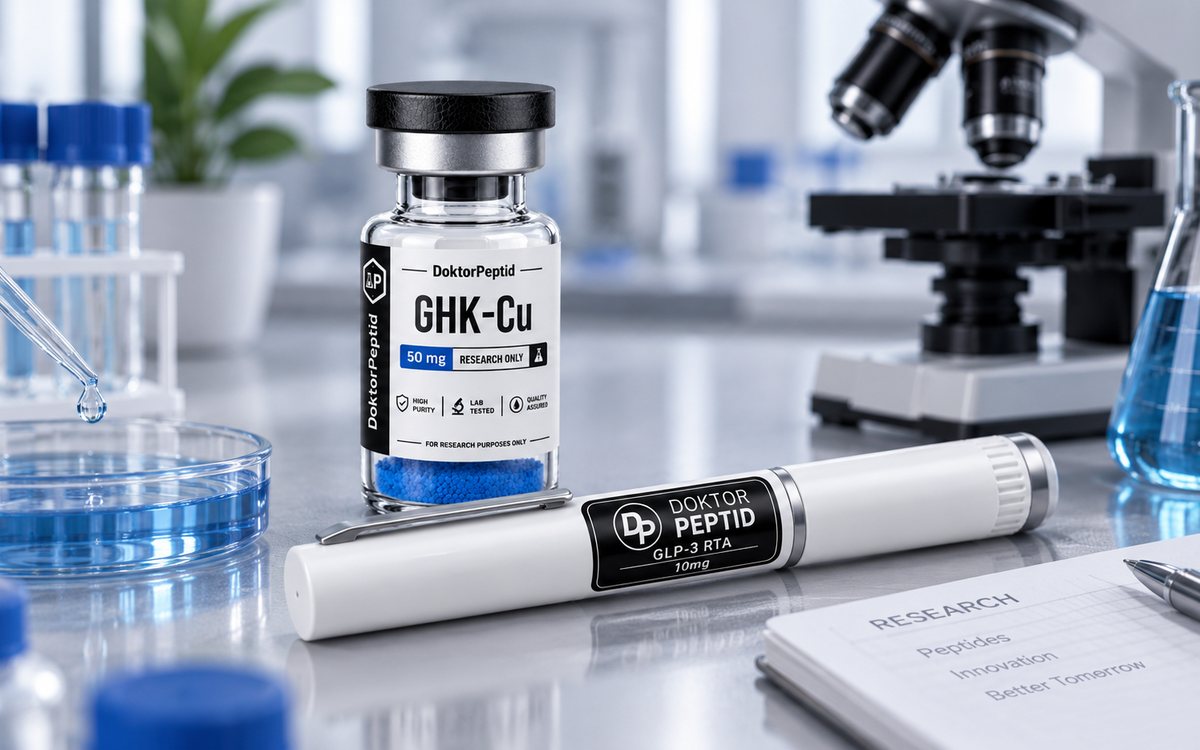
GHK-Cu is the subject of research in relation to skin biology, matrix remodeling and cellular stress response. When working with metal-containing complexes, special attention should be paid to system stability, compatibility with the medium and possible interferences in analytical evaluation.
Metabolism and hormonal signaling
Metabolic and growth peptides allow for the monitoring of receptor pathways related to energy, growth hormone, or body tissue composition regulation in appropriate experimental systems. Ipamorelin, Tesamorelin, or Retatrutide are examples of compounds where the research design must respect the distinction between receptor pharmacology, cellular observations, and the biological response of a complex organism.
In such projects, it is useful to include time points, negative and positive controls, and orthogonal validation methods. A single immunoassay or metabolic marker may not be sufficient to confirm a mechanism. If a result holds up to multiple independent methods, its interpretative value increases.
Cognitive and neurobiological models
Selank and Semax are being studied in a neurobiological context, for example in the context of stress response, neuromodulation and signaling in nerve cells. In this area, it is particularly important to avoid extrapolating findings from preclinical models to claims of effects in humans. The nervous system is complex and the choice of model, cell maturation, type of stress stimulus and method of quantification all influence the results.
Batch quality determines data quality
In peptide research, impurity, incorrect substance identity, or improper storage can invalidate even a well-designed experiment. Declared purity ≥99 % is therefore a relevant starting parameter, but not the only one. Purity alone does not confirm sequence identity, proper handling, or stability of the material during storage and sample preparation.
A trusted supplier has analytical documentation available for the batch. HPLC analysis provides information on the chromatographic profile and purity level, while mass spectrometry helps confirm the molecular weight and identity of the compound being analyzed. A batch analysis protocol should be available upon request and the labeling must allow traceability of the material in the laboratory documentation.
Equally important are storage under recommended conditions, limiting repeated thawing cycles, and keeping records of the preparation of working solutions. These steps are not an administrative formality. They help to distinguish a true biological phenomenon from variability caused by the material or handling.
How to set up a responsible experiment
Before ordering a research compound, it is worth preparing a brief experimental plan. It should state the hypothesis, model, primary outcome measure, controls, and analytical method. A vague hypothesis runs the risk of the laboratory collecting a large amount of data without answering a specific question.
When comparing peptides, do not automatically assume that a different result is evidence of superiority for one substance. Peptides may work through different mechanisms, and their comparison is only meaningful when the model, conditions, and methods are validly chosen. Replicates, blinded evaluation where possible, and transparent recording of deviations are often more valuable than an ambitious claim without data support.
DoktorPeptid approaches research compounds through batch quality control, declared purity, analytical documentation and clearly defined intended use. The products are intended exclusively for in vitro scientific purposes. They are not medicines, dietary supplements or materials for human or animal consumption.
The limits of evidence are part of good science
Interest in the biology of aging is naturally growing because it connects several dynamic areas of research. Nevertheless, for each compound, one must ask what type of evidence is available, in what model it was obtained, and what can realistically be inferred from it. Cell culture, organoid, animal model, and clinical evaluation are not interchangeable levels of knowledge.
The most valuable contribution of longevity peptides may not lie in a single big answer. It may lie in a more precise understanding of how cells respond to stress, repair structures, regulate energy, or communicate with their environment. When combined with analytically validated material, a disciplined protocol, and a willingness to respect data limits, even a small experiment can yield a result that can be built upon.
Related products
Produkty, ktorých sa táto téma týka: Ipamorelin – skladom na Slovensku, Tesamorelin – skladom na Slovensku, BPC-157 – skladom na Slovensku, TB-500 – skladom na Slovensku. Ceny a dostupnosť nájdete v sekcii všetky produkty, doplnky ako dávkovacie perá a zvýhodnené balíčky sú v samostatných kategóriách.
Všetky produkty sú určené výhradne na laboratórny výskum.